
: This was the kind of prison break officials say could have changed the region, and perhaps even the world, overnight.
Nearly 6,000 ISIS detainees, described by a senior U.S. intelligence official as ‘the worst of the worst,’ were being held in northern Syria as clashes and instability threatened the Kurdish-led Syrian Democratic Forces, the guards responsible for keeping the militants locked away and preventing a feared ISIS resurgence. U.S. officials believed that if the prisons collapsed in the chaos, the consequences would be immediate.
‘If these 6,000 or so got out and returned to the battlefield, that would basically be the instant reconstitution of ISIS,’ the senior intelligence official told Fox News Digital.
In an exclusive interview, the official walked Fox News Digital step by step through the behind-the-scenes operation that moved thousands of ISIS detainees out of Syria and into Iraqi custody, describing a multi-agency scramble that unfolded over weeks, with intelligence warnings, rapid diplomacy and a swift military lift.
The risk, the official explained, had been building for months. In late October, Director of National Intelligence Tulsi Gabbard began to assess that Syria’s transition could tip into disorder and create the conditions for a catastrophic jailbreak.
The ODNI sent the official to Syria and Iraq at that time to begin early discussions with both the SDF and the Iraqi government about how to remove what the official repeatedly described as the most dangerous detainees before events overtook them.
Those fears sharpened in early January as fighting erupted in Aleppo and began spreading eastward. Time was running out to prevent catastrophe. ‘We saw this severe crisis situation,’ the official said.
According to the source, the ODNI oversaw daily coordination calls across agencies as the situation escalated. The official said Secretary of State Marco Rubio was ‘managing the day to day’ on policy considerations, while the ODNI drove a working group that kept CENTCOM, diplomats and intelligence officials aligned on the urgent question: how to keep nearly 6,000 ISIS fighters from slipping into the fog of war.
The Iraqi government, the official said, understood the stakes. Baghdad had its own reasons to move quickly, fearing that if thousands of detainees escaped, they would spill across the border and revive a threat Iraq still remembers in visceral terms.
The official described Iraq’s motivation bluntly: leaders recognized that a massive breakout could force Iraq back into a ‘2014 ISIS is on our border situation once more.’
The U.S. Embassy in Baghdad, the official said, played a pivotal role in smoothing the diplomatic runway for what would become a major logistical undertaking.
Then came the physical lift. The official credited CENTCOM’s surge of resources to make the plan real on the ground, saying that ‘moving in helicopters’ and other assets enabled detainees to be removed in a compressed timeframe.
‘Thanks to the efforts… moving in helicopters, moving in more resources, and then just logistically making this happen, we were able to get these nearly 6000 out in the course of just a few weeks,’ the official said.
The SDF, he said, had been securing the prisons, but its attention was strained by fighting elsewhere, fueling U.S. fears that a single breach could spiral into a mass escape. Ultimately, detainees were transported into Iraq, where they are now held at a facility near Baghdad International Airport under Iraqi authority.
The next phase, the official said, is focused on identification and accountability. FBI teams are in Iraq enrolling detainees biometrically, the official said, while U.S. and Iraqi officials examine what intelligence can be declassified and used in prosecutions.
‘What they were asking us for, basically, is giving them as much intelligence and information that we have on these individuals,’ the official said. ‘So right now, the priority is on biometrically identifying these individuals.’
The official said the State Department is also pushing countries of origin to take responsibility for their citizens held among the detainees.
‘State Department is doing outreach right now and encouraging all these different countries to come and pick up their fighters,’ he said.
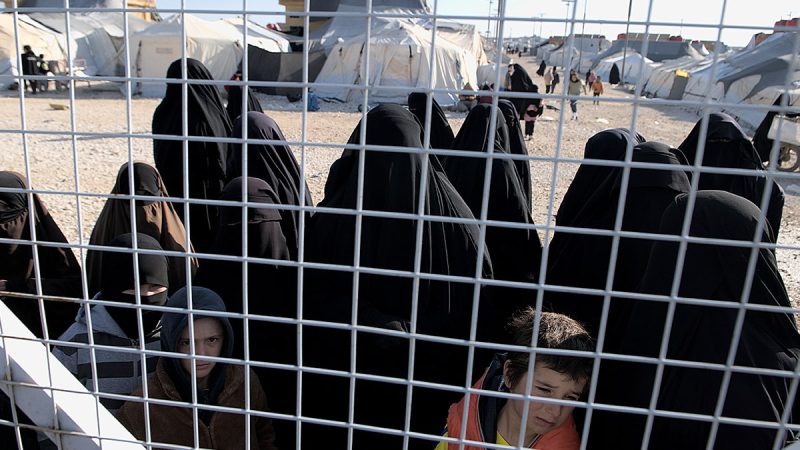
While the transfer focused strictly on ISIS fighters, the senior intelligence official said families held in camps such as al-Hol were not part of the operation, leaving a major unresolved security and humanitarian challenge.
The camps themselves were under separate arrangements, the official said, and responsibility shifted as control on the ground evolved.
According to the official, the Syrian Democratic Forces and the Syrian government reached an understanding that Damascus would take over the al-Hol camp, which holds thousands of ISIS-affiliated women and children.
‘As you can see from social media, the al-Hol camp is pretty much being emptied out,’ the official said, adding that it ‘appears the Syrian government has decided to let them go free,’ a scenario the official described as deeply troubling for regional security. ‘That is very concerning.’
The fate of the families has long been viewed by counterterrorism officials as one of the most complicated, unresolved elements of the ISIS detention system. Many of the children have grown up in camps after ISIS lost territorial control, and some are now approaching fighting age, raising fears about future radicalization and recruitment.
For now, the official said, intelligence agencies are closely tracking developments after a rapid operation that, in their view, prevented thousands of experienced ISIS militants from reentering the battlefield at once and potentially reigniting the group’s fighting force.
‘This is a rare good news story coming out of Syria,’ the official concluded.